
Is SAOS Legit or a Scam? Key Red Flags to Know


KEY TAKEAWAYS
SAOS is better viewed as a high-risk narrative token than a confirmed oil-backed asset.
The project’s oil-reserve branding should not be confused with legal ownership of oil or government backing.
Major red flags include vague asset claims, official-sounding language, uncertain utility, and low-cap volatility.
Beginners should verify the contract address, liquidity, holder distribution, and project documentation before taking action.
A scam-or-legit judgment should rely on evidence, not social media hype or fast price movement.
What Is SAOS?
SAOS, short for Strategic American Oil Supply, is a crypto token on Solana that uses the language of oil reserves and energy security. Traders comparing emerging tokens can start crypto trading on WEEX while using the same basic checklist: confirm the contract, inspect liquidity, review wallet distribution, and separate market stories from verifiable data.
SAOS stands out because it does not use the usual meme coin style. Instead, it borrows from commodity-market language, which may appeal to beginners who already understand oil as a real-world asset. Still, a token can reference a real asset without giving holders legal rights to that asset.
Is SAOS Legit or a Scam?
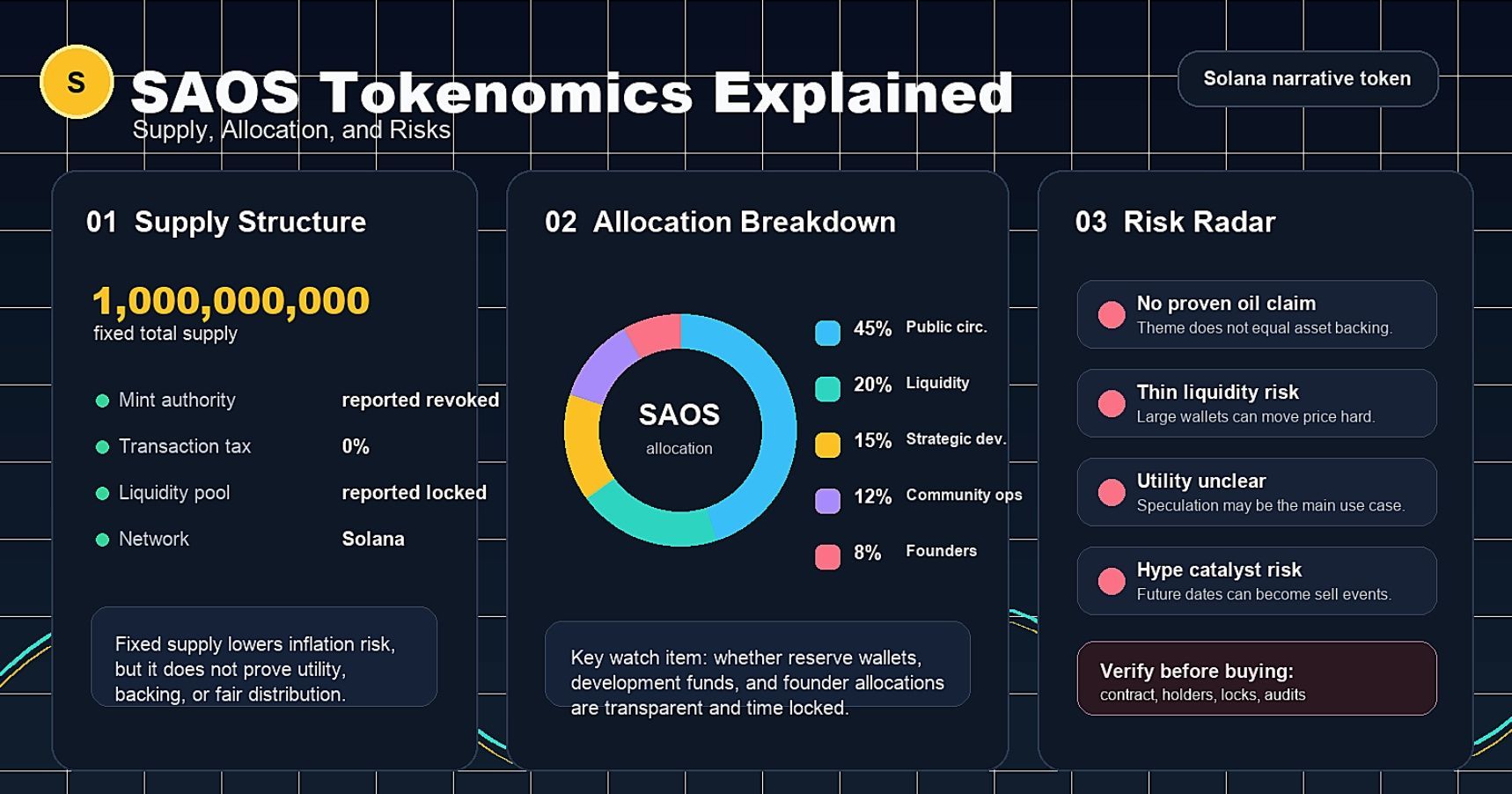
It is more accurate to say SAOS carries major red flags than to make a simple scam-or-not claim without full legal evidence. The token appears to exist and trade on-chain, which means it is not imaginary. But tradability alone does not prove legitimacy.
A legitimate crypto project should make basic answers easy to find. Who controls the wallets? Is liquidity locked? Is mint authority disabled? Are there audits? What rights do token holders receive? If the answers are unclear, traders should assume higher risk. In crypto, missing information is not neutral; it often becomes part of the risk.
Red Flag 1: Oil Branding Without Clear Asset Rights
The biggest SAOS red flag is the gap between the oil-reserve narrative and proof of asset backing. A token that mentions oil does not automatically represent oil ownership, revenue sharing, storage rights, or redemption rights.
Real-world asset tokens usually need legal structures, custody reports, reserve audits, and clear redemption rules. If a project cannot show how the token connects to the underlying asset, the branding may function more like a trading story than a financial claim. Beginners should be careful with any token that sounds like a commodity product but does not provide commodity-grade documentation.
Red Flag 2: Official-Sounding Language
SAOS uses terms that may remind readers of public policy, national reserves, and institutional finance. Words like “strategic,” “American,” “oil,” and “supply” can make a project feel more formal than a typical meme coin.
That effect can be powerful. Many traders react to branding before checking details. But official-sounding language does not prove government affiliation, regulatory approval, or institutional support. Anyone can launch a token and build a polished website around a serious theme. The stronger the branding, the more important it becomes to verify the substance behind it.
Red Flag 3: Unclear Utility
A useful token normally has a defined role. It may support governance, staking, fee discounts, DeFi collateral, protocol access, or revenue-linked mechanics. For SAOS, the main visible appeal appears to be the oil narrative and speculative trading interest.
That does not mean the token cannot rise in price. Narrative tokens can move sharply when attention increases. The issue is durability. If buyers only enter because they expect other buyers to arrive later, the market can reverse quickly when momentum fades. A stronger SAOS case would require clear product use, transparent roadmap execution, and measurable adoption beyond price speculation.
Red Flag 4: Low-Cap Liquidity Risk
Low-cap tokens often move faster than major crypto assets because liquidity is thinner. SAOS traders should pay close attention to pool depth, slippage, and trade size. A chart may show strong gains, but the actual exit price can be much worse if liquidity is shallow.
This is where beginners often get caught. Market cap can look attractive, yet a single large wallet can shift the price. Before trading SAOS, check whether buying and selling can happen at reasonable slippage. If a small trade changes the price heavily, the token is much riskier than the headline chart suggests.
Red Flag 5: Holder Concentration
Holder distribution is one of the most important checks for SAOS. If a few wallets control a large share of supply, they can influence price action by selling, transferring, or adding liquidity at key moments.
Beginners should review the top wallets, look for connected addresses, and monitor whether large holders are accumulating or distributing. A fair-looking token supply does not help much if actual ownership is concentrated. In low-cap markets, wallet behavior often matters more than marketing. If large wallets move before major announcements, that is another reason to slow down and reassess.
Red Flag 6: Future Catalyst Hype
Some tokens rely on near-term dates, teasers, or vague announcements to build urgency. That can create fast attention, but it also increases emotional trading. When traders buy because they fear missing an event, they may skip basic checks.
With SAOS, any future catalyst should be judged by substance. A real milestone would include verifiable partnerships, audited asset documentation, exchange transparency, product functionality, or on-chain improvements. A vague announcement, countdown, or social media push is weaker evidence. If the event does not improve fundamentals, it may only serve short-term speculation.
How to Check SAOS Before Trading
A practical SAOS research framework starts with the contract address. Confirm that you are viewing the correct token and not a copycat. Then check total supply, mint permissions, liquidity status, holder concentration, and recent large transfers.
Next, read the project’s public materials with a skeptical eye. Look for specific claims, not broad language. If the project says it is connected to oil, ask how that connection works legally and operationally. If the project claims transparency, look for wallet labels, audits, and verifiable records. Good research does not remove risk, but it helps avoid obvious traps.
SAOS Trading Framework for Beginners
The safer way to approach SAOS is to define the thesis before entering. If the thesis is short-term narrative momentum, then volume, liquidity, and social activity matter most. If the thesis is real-world asset exposure, then legal proof and reserve documentation matter most.
Do not mix those two ideas. A narrative trade is different from an asset-backed investment. Treating one as the other can lead to poor decisions. Beginners should also decide in advance how much loss they can tolerate, how they will exit, and what evidence would make them change their view.
Final Thoughts on SAOS Risk
SAOS has a strong theme, but strong themes do not equal strong fundamentals. The token may attract attention because oil, energy security, and real-world asset narratives are easy to understand. The risk is that beginners may mistake branding for backing.
For now, SAOS should be approached as a speculative, high-risk crypto token until stronger proof appears. The main questions are simple: what does the token truly represent, who controls the supply, how deep is liquidity, and what real utility supports demand after the hype cools?
FAQ
1. Is SAOS legit?
SAOS appears to be a tradable Solana token, but that alone does not make it a low-risk or fully verified project. A cautious view is to treat SAOS as a high-risk narrative token unless the project provides clearer proof of asset backing, wallet transparency, audits, and long-term utility.
2. Is SAOS a scam?
There is not enough public evidence to label SAOS definitively in simple terms, but the red flags are serious. Oil-themed branding, unclear asset rights, low-cap volatility, and uncertain utility all require caution. If anyone promotes SAOS as guaranteed, government-backed, or risk-free, that should be treated as a major warning sign.
3. What should I review before buying SAOS?
Review the contract address, liquidity depth, top-holder concentration, token permissions, project documentation, and whether SAOS has real utility beyond trading. For broader exchange ecosystem research, users can also review WEEX Token (WXT). New users may check the WEEX welcome bonus, which can include trading bonuses, coupons, or task-based rewards tied to account setup, deposits, or trading activity.
DISCLAIMER: WEEX and affiliates provide digital asset exchange services, including derivatives and margin trading, onlywhere legal and for eligible users. All content is general information, not financial advice-seek independentadvice before trading. Cryptocurrency trading is high risk and may result in total loss. By using WEEX services you accept all related risks and terms. Never invest more than you can afford to lose. See our Terms of Use and Risk Disclosure for details.
You may also like

SLX Airdrop: Share 50,000 USDT, 0-Fee Trading, Multiple Rewards
This guide explains how the SLX Airdrop works, what rewards are on offer, who’s eligible, and practical ways…

What Is USNS Crypto? Full Guide to this Oil Narrative Memecoin
What is USNS crypto? A look inside the oil narrative memecoin on Solana. No barrels, no reserves — just hype, headlines, and high risk. Read before you trade.
Introducing Citrea ($CTR): Bitcoin Application Layer and Price Prediction
Citrea is Bitcoin's application layer. CTR is gaining attention after trading, staking, and governance went live.
$CTR Airdrop on WEEX: Complete Guide to Citrea and Claim Free $CTR
Learn Citrea's Bitcoin application-layer ecosystem, $CTR tokenomics, and how to claim free CTR campaign rewards through the WEEX 50,000 USDT CTR airdrop before June 2, 2026 at 21:00 UTC+8.

What is Solstice (SLX) Coin
Solstice (SLX) Coin, now available on WEEX for trading since May 25, 2026, is a groundbreaking cryptocurrency focusing…

What is MP Materials Tokenized Stock (MPON) Coin?
The MP Materials Tokenized Stock (MPON) Coin has been newly listed on WEEX, with trading opening on May…

What is Ratspeak (RATSPEAK) Coin?
Ratspeak (RATSPEAK) Coin has made its debut on WEEX, a prominent cryptocurrency exchange. This innovative token was listed…
What is IBM Tokenized Stock (IBMON) Coin?
The rapidly evolving landscape of digital assets presents yet another opportunity for crypto traders with the recent listing…
What is Nebius Group (NBISON) Coin?
The Nebius Group (NBISON) Coin has been newly listed on WEEX, allowing crypto enthusiasts to trade this exciting…
What is Navacoin (NAVA) Coin
Navacoin (NAVA) has recently secured a listing on the renowned WEEX Exchange, allowing enthusiasts and investors to engage…
What is The Most Valuable Currency (ATTENTION) Coin?
Recently making waves in the crypto community, The Most Valuable Currency (ATTENTION) Coin has been listed on WEEX…
What is Gitbank (GITBANK) Coin?
Gitbank has just been listed on WEEX Exchange as of May 21, 2026, providing an exciting new trading…
What is Surplus Intelligence(SURPLUS) Coin? Everything You Need to Know to Trade SURPLUS/USDT
This article explains what Surplus Intelligence (SURPLUS) is, why it matters in the AI crypto category, how it…
What is Root Edge (ROOTAI) Coin?
The new cryptocurrency, Root Edge (ROOTAI), is making waves in the cryptosphere as it gets newly listed on…

Meme Coin Comparison: DOGE PEPE BONK Maxi Doge Market Analysis
Meme coins such as DOGE, PEPE, BONK, and Maxi Doge are shaped by sentiment, liquidity, and short-term trading behavior rather than traditional fundamentals. This article compares their market structure, price behavior, and narrative differences to explain how each meme coin reacts under changing market conditions.
Nebius Group (NBISON) Coin Price Prediction for May 2026: Forecast After WEEX Listing, Can Momentum Hold Above $219?
Nebius Group (NBISON) Coin began trading on WEEX at 06:00 UTC today, with launch-hour liquidity building around the…
ISOR vs OSOR, SAOS, and NOAR: why oil-reserve tokens are trending
ISOR, OSOR, SAOS, and NOAR are part of a new wave of oil-themed Solana tokens using reserve-style branding, national energy language, and real world asset narratives. The theme is easy to understand: oil is familiar, geopolitics moves markets, and “reserve” sounds more serious than a normal meme coin. But beginners should be careful. These tokens may trade on oil-related attention, yet that does not mean holders own oil, receive oil revenue, or have legal claims on physical reserves.
Maxi Doge Token Price Analysis: Why It Is Trending
Maxi Doge token price has gained strong attention as trading activity increases across speculative crypto markets. This guide explains why Maxi Doge is trending, what is driving the surge in attention, how its branding differs from traditional meme coins, and whether current momentum can continue in volatile market conditions.
SLX Airdrop: Share 50,000 USDT, 0-Fee Trading, Multiple Rewards
This guide explains how the SLX Airdrop works, what rewards are on offer, who’s eligible, and practical ways…
What Is USNS Crypto? Full Guide to this Oil Narrative Memecoin
What is USNS crypto? A look inside the oil narrative memecoin on Solana. No barrels, no reserves — just hype, headlines, and high risk. Read before you trade.
Introducing Citrea ($CTR): Bitcoin Application Layer and Price Prediction
Citrea is Bitcoin's application layer. CTR is gaining attention after trading, staking, and governance went live.
$CTR Airdrop on WEEX: Complete Guide to Citrea and Claim Free $CTR
Learn Citrea's Bitcoin application-layer ecosystem, $CTR tokenomics, and how to claim free CTR campaign rewards through the WEEX 50,000 USDT CTR airdrop before June 2, 2026 at 21:00 UTC+8.
What is Solstice (SLX) Coin
Solstice (SLX) Coin, now available on WEEX for trading since May 25, 2026, is a groundbreaking cryptocurrency focusing…
What is MP Materials Tokenized Stock (MPON) Coin?
The MP Materials Tokenized Stock (MPON) Coin has been newly listed on WEEX, with trading opening on May…


