
Alibaba Stock in 2026: Price, Forecast, and How to Trade BABA


Alibaba stock (NYSE: BABA) has become one of the most argued-over names in global markets — cheap on paper, exposed to real political risk, and quietly rebuilt around AI and cloud. As of July 8, 2026, BABA trades around $108.78, up sharply on the day but still far below its 52-week high of $192.67. The gap between where the stock trades and where analysts think it belongs is the whole story here.
This guide covers what Alibaba stock is worth today, why it trades at a discount, what could re-rate it, the risks that keep it cheap, and how traders are now getting Alibaba exposure using USDT instead of a brokerage account.
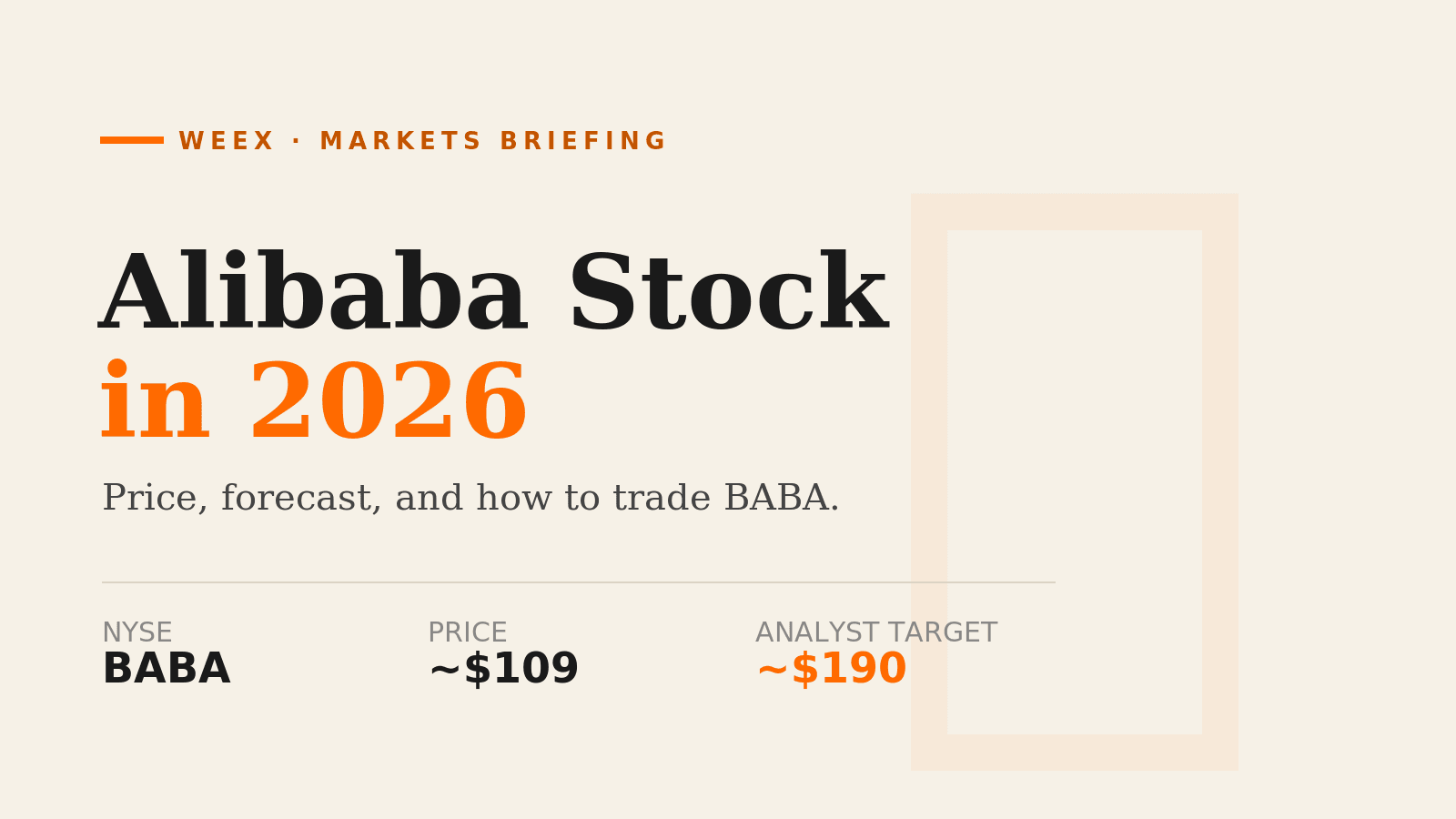
Alibaba Stock Snapshot: Price, Range, and Targets
Here is the fast version before the analysis.
| Metric | Value (as of July 8, 2026) |
|---|---|
| Price (BABA ADR) | ~$108.78 |
| 52-week range | $91.99 – $192.67 |
| Average analyst 12-month target | ~$190 |
| Typical target range | ~$180 (Morgan Stanley) to ~$225 (Jefferies) |
| Consensus rating | Strong Buy / Overweight bias |
The headline: analysts, on average, see roughly 70% upside to their 12-month target. That kind of spread almost never reflects a clean story — it reflects a market pricing in political and margin risk that the price targets discount more optimistically.
Why Alibaba Stock Trades So Far Below Its Highs
Alibaba is not cheap by accident. Three things weigh on it at once. First, profitability is under pressure: Alibaba is pouring money into AI infrastructure and its quick-commerce push, and that spending is compressing margins even as revenue grows. Second, competition in Chinese quick commerce against Meituan and JD.com is a subsidy war — expensive and margin-dilutive with no clear end date. Third, macro sentiment is soft: China set its 2026 GDP growth target at 4.5%–5%, among the lowest in decades, which pressures the entire basket of U.S.-listed Chinese tech names.
The more important point for traders: BABA's discount is a sentiment discount layered on a fundamental recovery. Those two forces can stay dislocated far longer than a valuation model suggests.
What Could Push BABA Higher: The AI and Cloud Case
The bull case is no longer just "it's cheap." It's the cloud and AI ramp. Alibaba's Cloud Intelligence external revenue has accelerated to around 40% growth, with AI-related product revenue now roughly 30% of external cloud revenue and posting triple-digit growth for eleven straight quarters. Management has set a five-year target of more than $100 billion in external cloud and AI revenue.
If that ramp holds, Alibaba stops being a slowing e-commerce company and starts being re-rated as China's leading AI-and-cloud infrastructure platform — a very different multiple. That re-rating, not a retail rebound, is what most bullish targets near $200+ are really betting on.
The Pentagon Overhang and China Risk on BABA
This is the risk that a valuation table won't show you. On June 8, 2026, the Pentagon added Alibaba to its list of alleged Chinese military-linked companies. A California federal judge later ordered the U.S. Department of Defense to temporarily suspend the resulting lobbying ban, with a trial hearing scheduled for the week of August 31, 2026.
For traders, the takeaway is blunt: BABA carries headline risk that can gap the stock in either direction around specific dates. A favorable ruling could remove an overhang; an adverse one could reprice the ADR fast. Position sizing matters more here than on a typical large-cap, and event dates deserve to be on your calendar.
Is Alibaba Stock a Good Buy in 2026?
Short answer: it depends on which risk you're being paid to take. The reward is a possible AI-and-cloud re-rating toward analyst targets near $190. The price you pay for it is genuine geopolitical, competitive, and margin risk — none of which resolve on a predictable schedule.
| Bull case | Bear case |
|---|---|
| Cloud + AI revenue compounding ~40% | Margins squeezed by AI and quick-commerce spend |
| Valuation well below historical multiples | Subsidy war with Meituan/JD.com |
| Analyst targets ~$180–$225 | Pentagon listing + China macro drag |
| RWA / tokenization opening new demand | Headline risk can gap the stock |
For long-term investors who believe the cloud transformation is real, the current level is closer to opportunity than trap. For short-term traders, BABA is a volatility instrument — one that rewards discipline around catalysts and punishes oversized, un-hedged bets.
How to Trade Alibaba Stock Exposure With USDT on WEEX
You no longer need a U.S. brokerage account, market-hours timing, or FX conversions to trade Alibaba's price. Through WEEX TradFi, traditional-market assets are accessible directly with USDT, 24/7 — including weekends and after the U.S. close, which is exactly when China-related headlines often break.
There are two ways to get Alibaba exposure on WEEX:
| Method | What it is | Leverage |
|---|---|---|
| Spot tokenized stock | BABAON/USDT, an Ondo-issued token tracking BABA stock, bought and held like a share | None |
| Stock perpetual futures | USDT-settled perps tracking traditional assets, with funding every 8 hours | Up to 100x |
BABAON is a Real World Asset (RWA) token issued by Ondo that brings Alibaba's stock price on-chain, tradable as a spot pair with no leverage — closer to holding the stock than betting on it. For active traders, WEEX's TradFi perpetuals add leverage and round-the-clock access, with the standard caveat that leverage cuts both ways.
WEEX is also running a TradFi Trading Challenge with a $50,000 shared prize pool for eligible users trading TradFi spot and futures pairs. Full mechanics, eligible pairs, and reward rules are on the TradFi event page, and the broader WEEX TradFi 2026 guide walks through fees, funding, and how stock perps are priced when Wall Street is closed.
The Bottom Line on Alibaba Stock
Alibaba stock in 2026 is a classic risk-versus-re-rating trade: a cheap price, a credible AI-and-cloud growth engine, and a stack of political and margin risks that keep the market cautious. Whether you hold BABA for the long-term cloud thesis or trade its swings around catalysts, the discipline is the same — respect the headline risk and size positions accordingly. If you want to act on a view without a broker, tokenized BABAON and WEEX TradFi perpetuals let you trade Alibaba's price with USDT, any hour of the week.
FAQ
1. What is Alibaba stock trading at right now?
As of July 8, 2026, Alibaba's ADR (BABA) trades around $108.78, within a 52-week range of $91.99 to $192.67. Prices change constantly, so confirm the live quote before acting.
2. Is Alibaba stock a good investment in 2026?
Analysts lean bullish, with an average 12-month target near $190 and a Strong Buy tilt, driven by AI and cloud growth. But BABA carries real geopolitical, competitive, and margin risks, so it suits investors comfortable with volatility rather than those seeking stability.
3. Why is Alibaba stock so cheap compared to its highs?
The discount reflects margin pressure from heavy AI and quick-commerce spending, a costly subsidy war with Meituan and JD.com, weak China macro sentiment, and U.S. political risk after the Pentagon's June 2026 military-linked listing.
4. Can I buy Alibaba stock with crypto or USDT?
Yes — indirectly. WEEX lists BABAON, an Ondo-issued RWA token that tracks Alibaba's stock price and trades as a spot pair against USDT. WEEX TradFi also offers USDT-settled stock perpetual futures for leveraged, 24/7 exposure.
5. What is BABAON on WEEX?
BABAON is a tokenized version of Alibaba (BABA) stock issued by Ondo, listed on WEEX's spot market as BABAON/USDT. It lets you trade Alibaba's price on-chain with USDT, without a traditional brokerage account.
Risk Warning
Trading Alibaba stock exposure — whether via ADRs, tokenized BABAON, or stock perpetual futures — carries significant risk. BABA is subject to sharp, headline-driven moves from U.S.–China policy, regulatory action, and earnings surprises, and prices can gap outside market hours. Tokenized stocks like BABAON add custody, issuer, liquidity, and redemption risk, and their price can diverge from the underlying share. Perpetual futures add leverage and liquidation risk: with up to 100x leverage, a small adverse move can wipe out your margin, and funding costs accrue while positions are open. Never trade with funds you cannot afford to lose, and size positions with catalyst dates in mind.
Disclaimer: This content is provided for general informational and educational purposes only and should not be considered financial, investment, legal, or tax advice. Nothing in this article constitutes an offer, recommendation, solicitation, or invitation to buy, sell, or trade any crypto asset or use any specific service. Crypto assets are highly volatile and involve a high degree of risk. You may lose some or all of the value of your investment and should not invest funds you cannot afford to lose. WEEX services may not be available in all regions and are subject to applicable laws, regulations, and user eligibility requirements. Please carefully assess risks and confirm local requirements before making any financial decisions.